Data-efficient imitation learning improves driving behaviour.
Qualitative comparisons from the data-efficient imitation-learning results show how the spline-parameterized policy handles urban interactions compared with the Urban Driver baseline.
1 Department of Cognitive Robotics, Delft University of Technology, Delft, the Netherlands
2 Siemens Digital Industries Software, Leuven, Belgium
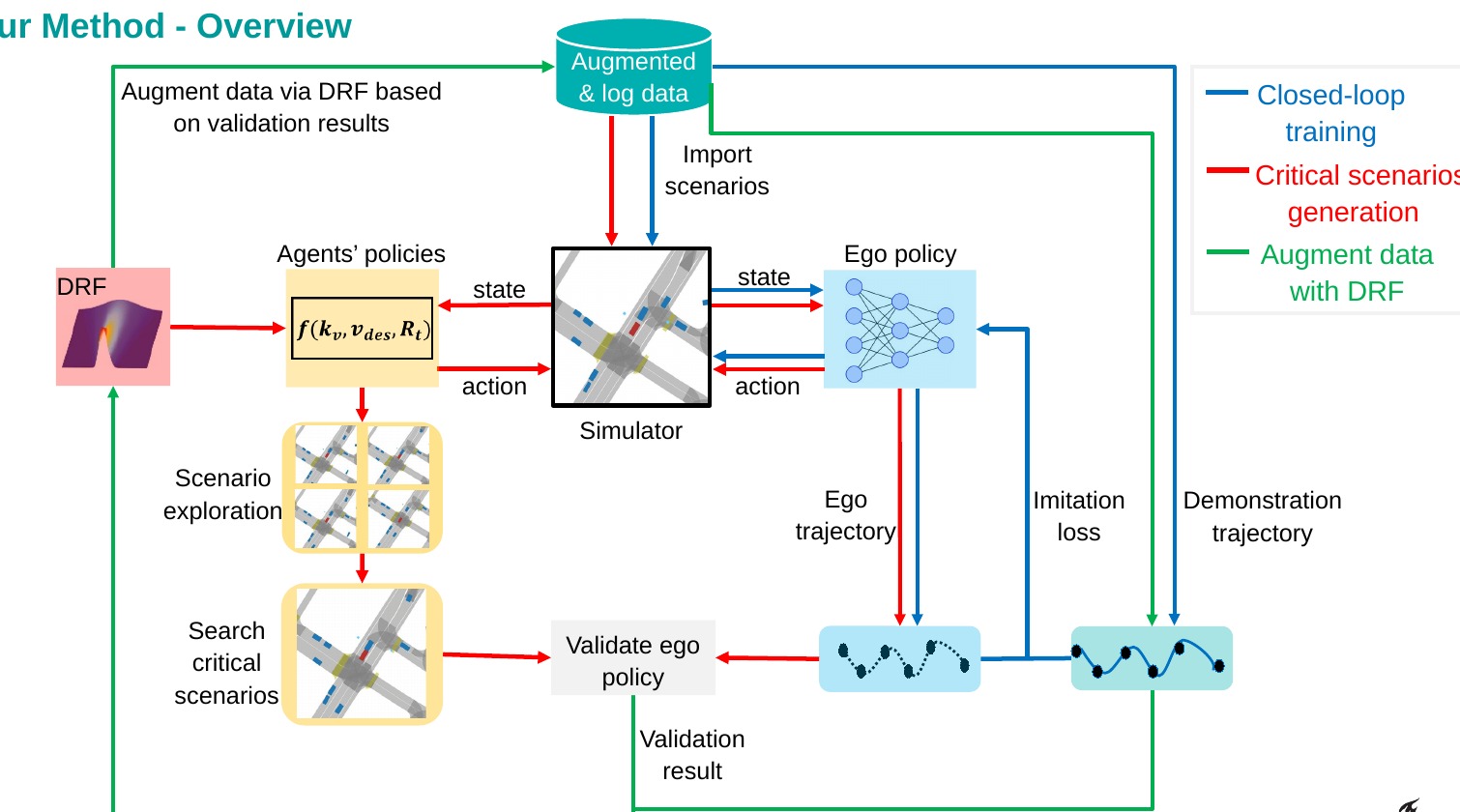
This work uses Driver’s Risk Field to generate safety-critical simulation scenarios and augment demonstrations for data-efficient imitation learning in autonomous driving.
Qualitative comparisons from the data-efficient imitation-learning results show how the spline-parameterized policy handles urban interactions compared with the Urban Driver baseline.
DRF-based traffic agents generate critical interactions that reveal failures not exposed by the ordinary logged scenario. These side-by-side videos show how a critical scenario can turn a hidden weakness into an observable failure.
Critical data augmentation targets passive-driving failure modes: before retraining, the policy drives passively; after retraining, it performs a more normal speed-up in the same type of interaction.