Yurui Du

PhD student working on robot learning, world models, embodied AI, and visual model predictive control.

My research focuses on learning systems that enable embodied agents to plan and act under partial observability, visual occlusion, and model uncertainty.

From strategic intelligence to physical intelligence.

My interest in intelligent systems started before university through Go. In high school, I played Go competitively and became a provincial champion. Like many Go players, I was amazed by AlphaGo’s superhuman performance. Yet one detail left a stronger impression on me than the victory itself: even when AlphaGo could decide where to play, a human still had to physically place the stones on the board.

That contrast shaped how I thought about intelligence. Strategic reasoning could already exceed human experts in a clean symbolic world, while acting in the physical world remained much harder. A real robot must perceive incomplete surroundings, model uncertain dynamics, move through hardware constraints, and recover from noisy feedback.

This belief guided my academic path: mechanical engineering in my bachelor’s degree to understand physical systems, robotics in my master’s degree to connect perception, planning, and control, and electrical engineering in my PhD to study learning-based visual control and embodied AI.

I am interested in physical intelligence: systems that can reason, move, and adapt in the real world.
Recent updates.

2026
RSS 2026. Our work ELVIS: Ensemble-Calibrated Latent Imagination for Long-Horizon Visual MPC was accepted by Robotics: Science and Systems 2026.
2025
RA-L / CASE 2025. AREPO: Uncertainty-Aware Robot Ensemble Learning Under Extreme Partial Observability was accepted by IEEE Robotics and Automation Letters and presented at CASE 2025.
2025
RoBetArme final demo. We demonstrated robotic material deposition in the Alps as part of the RoBetArme project.

Research interests.

Embodied AI and robot learning

Learning systems that perceive, plan, and act in the physical world under uncertainty and deployment constraints.

World models and planning

Latent dynamics, world action models, long-horizon imagination, model-based RL, and visual MPC.

Uncertainty and robustness

Partial observability, visual occlusion, uncertainty-aware returns, ensemble calibration, and sim-to-real transfer.

Selected research projects.

The three main project pages are now organized as standalone visual paper pages: ELVIS, AREPO, and LFD-DRF.

Project context

RoBetArme: final demo in the Alps

RoBetArme is the physical robotics context that shaped my current research direction. The project targets robotic material deposition in challenging construction environments, where perception, control, material flow, and hardware constraints must be handled together.

This project motivated my focus on robot learning methods that connect visual perception, uncertainty, simulation, planning, and real-world validation.

Construction Robotics Embodied AI Visual Occlusion Real Robot Systems
RSS 2026

ELVIS: Ensemble-Calibrated Latent Imagination for Long-Horizon Visual MPC

ELVIS is a latent model predictive control framework for long-horizon visual control. It plans inside a Dreamer-style recurrent state space world model and uses Gaussian-mixture MPPI to maintain multiple coherent action hypotheses over long horizons.

An ensemble-calibrated uncertainty-aware return stabilizes deep imagination and aligns actor-critic learning with trajectory optimization.

World Models Visual MPC Sim-to-Real Uncertainty MPPI
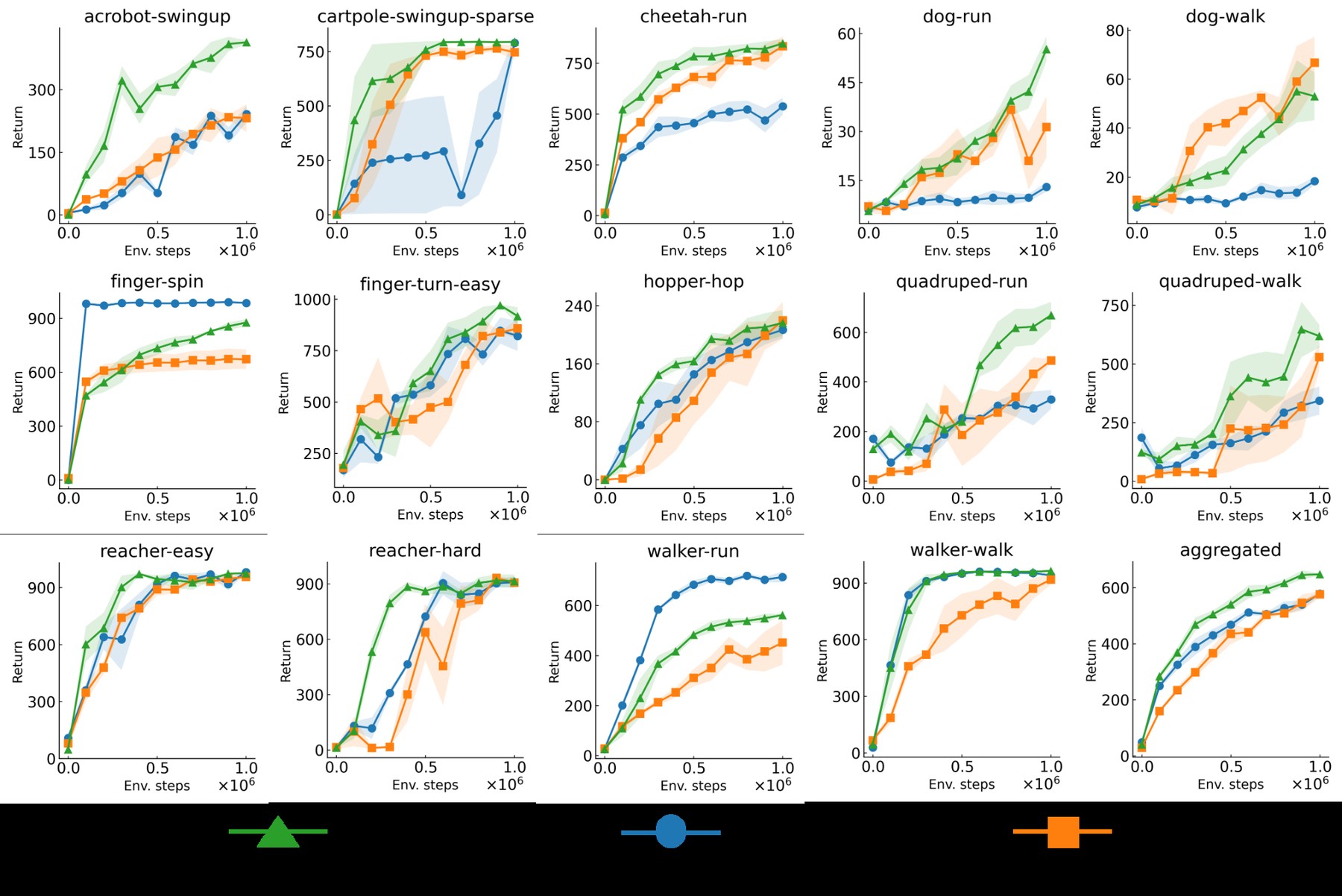
ELVIS 14-task visual control training curves
Visual control benchmark results over 14 DeepMind Control Suite tasks.
RA-L 2025 · CASE 2025

AREPO: Uncertainty-Aware Robot Ensemble Learning Under Extreme Partial Observability

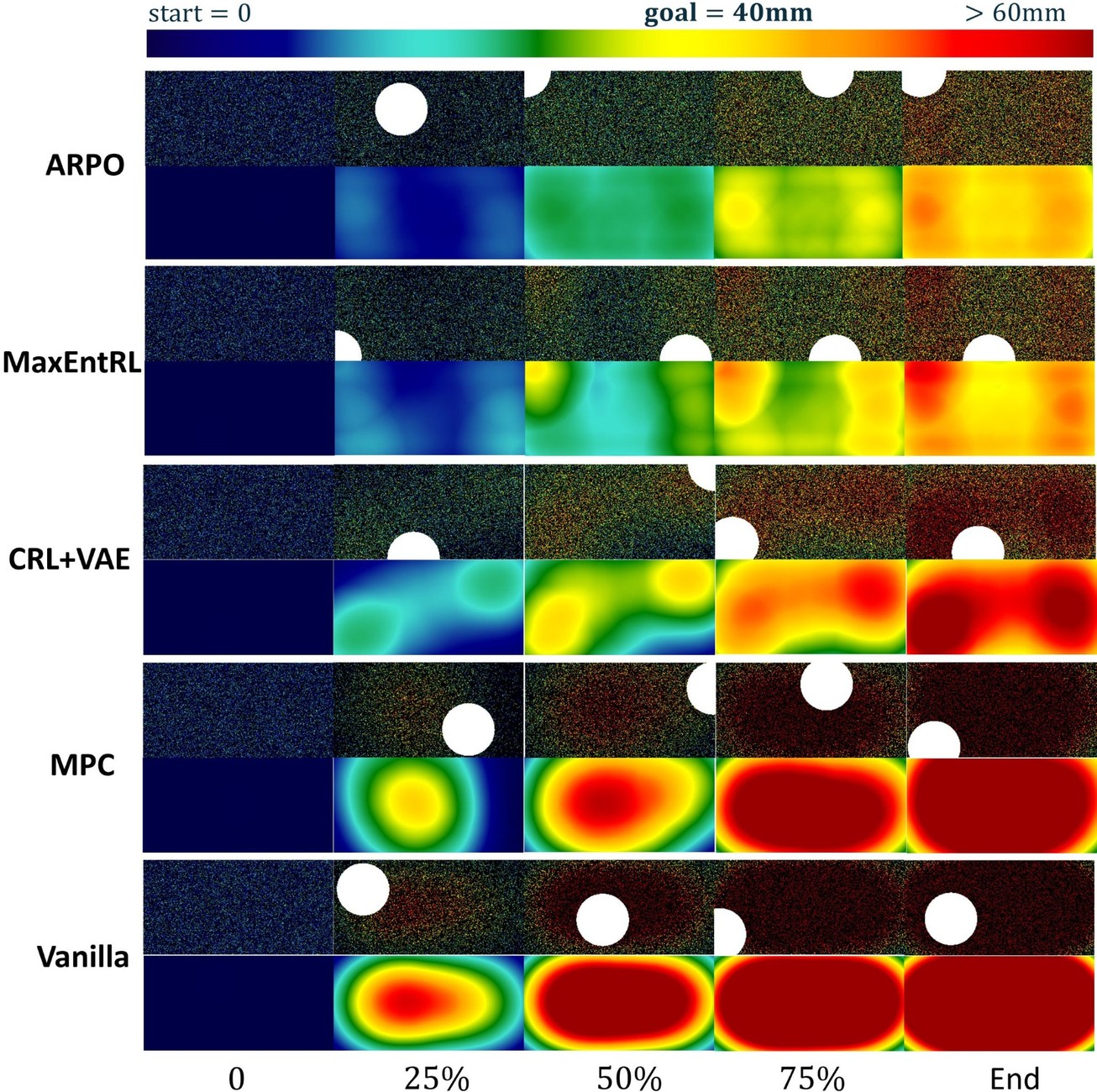
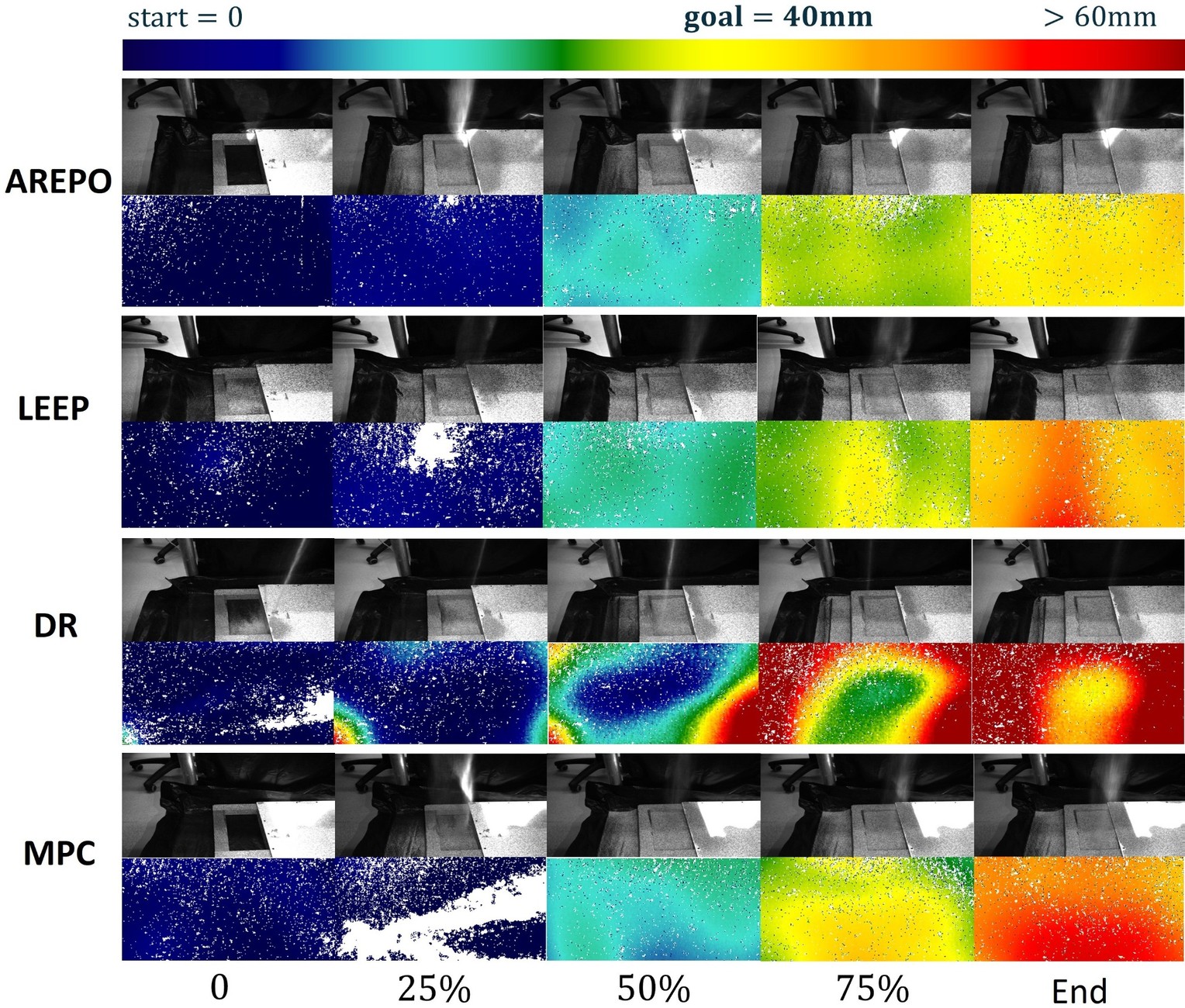
AREPO studies uncertainty-aware robot learning for visual control tasks with severe partial observability. The method combines visual representation learning, uncertainty-guided reinforcement learning, and ensemble-based policy learning to improve robustness under occluded observations and sim-to-real shift.

This work was accepted by IEEE Robotics and Automation Letters in 2025 and presented at CASE 2025.

Robot Learning Sim-to-Real Uncertainty Visual RL
AREPO real-world sim-to-real experiment comparison
Real-world sim-to-real comparison under severe visual occlusions.
AREPO simulation training comparison
Simulation training comparison for uncertainty-aware visual reinforcement learning.
Autonomous driving / IFAC

Learning from Demonstrations of Critical Driving Using Driver’s Risk Field

This work studies imitation learning for autonomous driving in safety-critical scenarios. It uses Driver’s Risk Field agents to generate realistic interactive traffic scenarios and improve the safety and efficiency of learned motion planning policies.

Imitation Learning Simulation Risk Modeling Critical Scenarios

Publications.

ELVIS: Ensemble-Calibrated Latent Imagination for Long-Horizon Visual MPC
Yurui Du, Pinhao Song, Yutong Hu, and Renaud Detry. Robotics: Science and Systems, 2026.
Robot Trajectron V2: A Probabilistic Shared Control Framework for Navigation
Pinhao Song, Yurui Du, Ophelie Saussus, Sofie De Schrijver, Irene Caprara, Peter Janssen, and Renaud Detry. The International Journal of Robotics Research, 2026.
AREPO: Uncertainty-Aware Robot Ensemble Learning Under Extreme Partial Observability
Yurui Du, Louis Hanut, Herman Bruyninckx, and Renaud Detry. IEEE Robotics and Automation Letters, 2025.
Robotic Framework for Iterative and Adaptive Profile Grading of Sand
Louis Hanut, Yurui Du, Andrew Vande Moere, Renaud Detry, and Herman Bruyninckx. IEEE International Conference on Robotics and Automation, 2025.
Learning from Demonstrations of Critical Driving Behaviours Using Driver’s Risk Field
Yurui Du, Flavia Sofia Acerbo, Jens Kober, and Tong Duy Son. IFAC-PapersOnLine, 2023.

Experience and education.

Jul 2023 – Present
KU Leuven — PhD Student in Electrical Engineering
Robot learning, world models, visual MPC, uncertainty-aware RL, and sim-to-real transfer.
Dec 2022 – Apr 2023
Meituan — Autonomous Driving Engineer
Planning, control, testing, and simulation for autonomous delivery vehicles.
Sep 2020 – Jul 2022
Delft University of Technology — MSc in Robotics
Robotics, perception, planning, and control.
Jul 2021 – Oct 2022
Siemens Digital Industries Software — Autonomous Driving Intern / Thesis Student
Traffic simulation, Driver’s Risk Field modeling, critical scenario generation, and imitation learning.
Sep 2016 – Jun 2020
Southeast University — BEng in Mechanical Engineering
Mechanical systems, control, simulation, and autonomous vehicle planning.
Jul 2020 – Oct 2020
Dongfeng Motor Corporation R&D Centre — Autonomous Driving Intern
Decision making and trajectory prediction for autonomous vehicles.